Sunday, 12 March 2023

The 4.50 From Paddington by Agatha Christie


Miss Marple #8

223 pages

Publisher: Agatha Christie Ltd/Planet Three Publishing

Library book


Blurb

For an instant the two trains ran together, side by side. In that frozen moment, Elspeth witnessed a murder. Helplessly, she stared out of her carriage window as a man remorselessly tightened his grip around a woman’s throat. The body crumpled. Then the other train drew away.

But who, apart from Miss Marple, would take her story seriously? After all, there were no suspects, no other witnesses... and no corpse.


Review

Poor Elspeth McGillicuddy. There she is, on a train to visit Miss Marple, when she witnesses a murder taking place in a passing train. She dutifully reports the crime to the police who duly investigate only to find no trace of evil doing. Since there appears to be no corpse and there are no other witnesses, they put her claim down to a bad dream. Miss Marple on the other hand, knows Elspeth and takes her claim seriously and after undertaking a few train journeys of her own, she has a pretty good idea of what may have happened to the body of the unfortunate victim. Miss Marple has no way of actively investigating the crime herself but, never one to be held back, she has a solution.

Enter…

Lucy Eyelesbarrow, who basically operates as Miss Marple’s eyes, ears, and legs is a fabulous character. First of all, there’s her name—Eyelesbarrow, how does Christie come up with names like this one? But most of all I love the idea that after successfully graduating from Oxford she decided to forgo a distinguished academic career to become a sort of highly skilled domestic labourer taking on jobs on a short-term basis for fast amounts of money.

Lucy Eyelesbarrow takes on a job in Rutherford Hall which happens to have grounds bordering the relevant train tracks and on a very expedient bend as well. Miss Marple takes up lodgings not too far away, allowing Lucy and later Detective Inspector Dermot Graddock to confer with her about what they discover and give voice to their frustration that the solution remains out of reach.

Apart from Lucy, Miss Marple, and Elspeth McGillicuddy, the following cast appears in this mystery and must therefore be considered suspects (with the exception of the investigating officers, of course):

Mrs. Kidder – Housekeeper

Mr. Crackenthorpe – Master of Rutherford Hall, invalid and very disagreeable and stingy with money.

Emma Crackenthorpe – Mistress of Rutherford Hall – Mr. Crackenthorpe’s daughter.

Edmund Crackenthorpe: Formerly the eldest son, killed in France during WW II.

Cedric Crackenthorpe – Middle son, a painter who lives abroad.

Harold Crackenthorpe – Youngest son, works in the City, married an Earl’s daughter.

Alfred Crackenthorpe – Eldest son, black sheep of the family.

James Stoddart-West – Alfred’s school friend.

Edith Crackenthorpe – Deceased daughter.

Mr. Bryan Eastley – Edith’s husband, still close with the family.

Master Alexander Eastley – Son of Edith and Bryan.

Dr. Quimper – GP.

Mr. Wimborne – Family Solicitor.

Martine – A French woman who might be the mysterious victim?

Inspector Bacon – Local Police

Detective Inspector Dermot Graddock – Scotland Yard and Sir Henry Clithering’s godson.

Lucy soon discovers that this is not a happy family. Mr. Crackenthorpe is rather stingy and seems to take delight in not helping his offspring financially, mostly because he feels hard done by as a result of his own father’s will. Unsurprisingly, his children, particularly his sons, aren’t all too fond of their father.

Two further murders take place later on in the story, which narrows the cast of suspects a little but it won’t surprise anybody when I say that the ultimate solution is rather surprising. It doesn’t come out of nowhere however, and looking back, the clues were there although I have to admit I missed them and failed to come up with the answers before Miss Marple revealed them in a rather shocking and delightful finale.

As I mentioned before, I really liked Lucy as a character. Another favourite was young Alexander because of his fascination with the crime and his determination to search for and find clues. While the other characters are all described vividly and come to life on the page, I can’t say I liked them very much. The three brothers were equally awful and selfish. Emma doesn’t show any selfishness but I found her a little bland, although that worked nicely in contrast to her brothers’ awfulness. I did like Dermot Graddock and the fact that his role in this story meant that Sir Henry Clithering got a mention in this book.

And that’s all I’m willing to say about this story. If you would like to know more you’ll have to read it. 😊

I picked this title because I’m currently listening to the All About Agatha podcast and this title is coming up soon. Past experience tells me that Catherine Brobeck and Kemper Donovan will be a lot more critical of this story, the characters, and the mystery than I am. In fact, if I have a criticism it is that Miss Marple doesn’t appear more prominently in this story. Other than that, this was a delightful mystery, well-plotted and executed, and a great read. Just what I would expect from the Queen of Crime.

Friday, 10 March 2023

The Close by Jane Casey


# 10 Maeve Kerrigan

416 pages

Publisher: Harper Collins

NetGalley


Blurb


At first glance, Jellicoe Close seems to be a perfect suburban street – well-kept houses with pristine lawns, neighbours chatting over garden fences, children playing together.

But there are dark secrets behind the neat front doors, hidden dangers that include a ruthless criminal who will stop at nothing.

It’s up to DS Maeve Kerrigan and DI Josh Derwent to uncover the truth. Posing as a couple, they move into the Close, blurring the lines between professional and personal as never before.

And while Maeve and Josh try to gather the evidence they need, they have no idea of the danger they face – because someone in Jellicoe Close has murder on their mind.


Review


As a rule, I don’t read books in a series out of order. I made an exception for this title when I found it on NetGalley simply because the blurb intrigued me. After finishing the story, I can say that being unfamiliar with the previous titles was somewhat of a mixed blessing.

Allowing the blurb to lure me into this book was the right decision though. The mystery (or should I say mysteries?) in this book was captivating, intriguing, and very well plotted. The blurb only reveals some of what is going on in this book which means we are dealing with an intriguing and action-packed story. I can’t say too much about all of that without risking spoilers, but I want to mention that this book kept me on my toes and managed to put me on the wrong footing as to the identity of the perpetrator(s). I loved the creepy insights into a murderer’s mind and the descent into madness they revealed while keeping their identity under wraps. In fact, the mysteries in this book and the outcomes were faultless and it was a delight to try and puzzle along (even if I got it wrong for the most part).

What didn’t work as well for me was the interaction between Maeve and Derwent. I don’t hold that against the book, though. This is book #10 in an ongoing series and I imagine that what transpires in this book has been set up over the course of the earlier releases. Furthermore, it is not as if you need to have read those earlier books to appreciate the complicated relationship between these two. There are enough references to what has gone before to ensure a new reader isn’t grasping around in the dark. Personally, I could have done with the blurb specifying that this book (series?) is almost as much about their complex interactions as it is about the mysteries they solve, but that is mostly because I’m not a huge fan of romance playing a (big) role in crime fiction. Again, if I had read one or more of the earlier titles, I would have been aware of this fact so it’s not something I hold against the author.

Overall, this was a gripping mystery with fascinating, lifelike, and well-portrayed characters. The plotting is tight, the resolutions are clever and (for the most part) surprising, and the writing was faultless. I’m not sure I’ll go back to read the previous titles but I will almost certainly read future titles in this series.


Wednesday, 1 March 2023

The Writing Retreat by Julia Bartz


Publisher: Magpie

Released: February 2023

320 pages

E-book

Netgalley


Blurb

A book deal to die for.


Five attendees are selected for a month-long writing retreat at the remote estate of Roza Vallo, the controversial high priestess of feminist horror. Alex, a struggling writer, is thrilled.

Upon arrival, they discover they must complete an entire novel from scratch, and the best one will receive a seven-figure publishing deal. Alex’s long-extinguished dream now seems within reach.

But then the women begin to die.

Trapped, terrified yet still desperately writing, it is clear there is more than a publishing deal at stake at Blackbriar Estate. Alex must confront her own demons – and finish her novel – to save herself.

This unhinged, propulsive, claustrophobic closed-door thriller will pull you in and spit you out…


Review

If the blurb sounds somewhat dark, it is because this is a dark story. Very dark. If I had to summarize the plot in one sentence I would say: All is fair when the goal is hitting the top spot on the bestsellers’ lists. But that statement may not be strong enough to convey what takes place on these pages.

Take five young writers desperate for their big break, add one bestselling mentor and put them together in an isolated house in the middle of nowhere for a month. The idea is that they each write a book from scratch during those four weeks. The means of keeping the writers on target are, how shall I put it, unconventional. But the promised reward to the person who produces the best story is huge, so whatever reservations our main character and narrator Kate might have are pushed to the back of her mind as she and the others dedicate their time to producing 3000 words every day to be judged by the fabulous Raz.

And that is more or less all I can tell you about the plot without spoiling the story. What I can say is that the story slowly but steadily gets darker, creepier, and more mysterious. While it becomes obvious that things are probably not exactly what they appear to be very early on, the full extent of the darkness doesn’t become clear until much further on. What’s more, it isn’t always clear whether or not we are dealing with something supernatural. Is Kate imagining things or are otherworldly powers (also) at play?

Kate, when the story starts, has issues and is very insecure. This state of mind is made worse by the fact that Wren, who used to be her best friend until they had a nasty falling out is also one of the contestants. But when one of the competing authors disappears, most other concerns take a back seat and Kate finds herself relying on strengths and qualities she didn't know she possessed.

In fact, this is as much a story about learning to have confidence in yourself and trusting your instincts and abilities as it is a cautionary tale asking the characters how much of themselves they are willing to sacrifice in return for fame. Overall, this was a thrilling but not always comfortable ride.


Saturday, 25 February 2023

And Then There Were None by Agatha Christie


276 pages

Kindle edition

First published November 6, 1939

Book Club read February 2023


Blurb

First, there were ten - a curious assortment of strangers summoned as weekend guests to a private island off the coast of Devon. Their host, an eccentric millionaire unknown to all of them, is nowhere to be found. All that the guests have in common is a wicked past they're unwilling to reveal - and a secret that will seal their fate. For each has been marked for murder. One by one they fall prey. Before the weekend is out, there will be none. And only the dead are above suspicion.


Review


Ten little soldier boys went out to dine;

One choked his little self and then there were Nine.

Nine little soldier boys sat up very late;

One overslept himself and then there were Eight.

Eight little soldier boys travelling in Devon;

One said he’d stay there and then there were Seven.

Seven little soldier boys chopping up sticks;

One chopped himself in halves ad then there were Six.

Six little soldier boys playing with a hive;

A bumble bee stung one and then there were Five.

Five little soldier boys going in for law;

One got in Chancery and then there were Four.

Four little soldier boys going out to sea;

A red herring swallowed one and then there were Three

Three little soldier boys walking in the Zoo;

A big bear hugged one and then there were Two.

Two little soldier boys sitting in the sun;

One got frizzled up and then there was One.

One little soldier boy left all alone;

He went and hanged himself and then there were None.


From the Author’s Note:

I had written this book because it was so difficult to do that the idea fascinated me.

As for me, I was fascinated from the opening few paragraphs describing several people making their way to a place called Soldier Island. Their destination may be the same, but they don’t know each other, aren’t aware others are making the same journey, or that they’ve all been invited under a different pretence.

As the blurb suggests, the guests are in for one or two unpleasant surprises. And chief among those is the fact that one by one they will be killed as punishment for deaths they have caused in the past but gotten away with.

I do not want to spoil this book for anybody who may not be familiar with the story or for those who, like me, read it so long ago that they've forgotten every single detail. Suffice to say that I was mesmerized by this tale and not just because it appeared to be an impossible crime. Once it becomes clear that the eight guests and two servants are the only people on the island, we know that the only possible explanation is that one of them has to be the deranged murderer. But if all of them die, how can that possibly be the case?

It's not just the mystery of who and how that kept me captivated. The slow but steady slide from disbelief via fear and anger to utter paranoia was fascinating. It was also very cleverly executed because Christie has a very light touch. In fact, if I had to pick one facet of this story that stood out over all others it would be her ability to show her reader darkness without ever spelling it out or layering it on with heavy strokes.

I have to hand it to Agatha Christie. Yes, the idea for this story is fascinating and it reads like an impossible-to-resolve mystery (even) more than her other stories. Yet, once all was revealed at the end of the story—and therefore much too late to save anybody’s life—it did makes sense and both motivation and means of execution convinced me. I’m not sure why that should surprise me; they don’t call Christie the Queen of Crime for nothing. 😊 In fact, if it hadn’t been for the wonderful and in-depth All About Agatha podcast, I would have been oblivious about the one plotting ‘mistake’ in this story.


I am delighted I picked this book for my book club and can’t wait for the discussion. Reading And Then There Were None also has made me even more determined to revisit more Agatha Christie mysteries. I rarely re-read any books but I’m looking forward to making an exception for her mysteries.


Wednesday, 22 February 2023

My Father's House by Joseph O'Connor

 My Father’s House (Rome Escape Line Trilogy #1) by Joseph O’Connor


276 pages

Publisher: Harvill Secker

Pub. Date: Jan 2023


Blurb

From the best-selling author of Star of the Sea, a WWII-era “great escape” novel set in the Vatican

September 1943: German forces occupy Rome. Gestapo boss Obersturmbannführer Paul Hauptmann rules with terror. Hunger is widespread. Rumors fester. The war’s outcome is far from certain.

Diplomats, refugees, and escaped Allied prisoners flee for protection into Vatican City, at one fifth of a square mile the world’s smallest state, a neutral, independent country within Rome. A small band of unlikely friends led by a courageous Irish priest is drawn into deadly danger as they seek to help those seeking refuge.

Book 1 in the Rome Escape Line Trilogy, My Father’s House is a powerful, heartbreaking literary thriller based on the true story of Monsignor Hugh O’Flaherty, who risked his life to smuggle thousands of Jews and escaped Allied prisoners out of Italy under the nose of his Nazi nemesis. A deadly high-stakes battle of wits ensues in this astonishing, unforgettable story of love, faith and sacrifice, exploring what it means to be truly human in the most extreme circumstances.


Review

I must start this review with a confession. I knew the story I was about to start reading was based on real events and that knowledge made me nervous. So I googled Monsignor Hugh O’Flaherty first because I had to know whether or not he survived the war, just to prepare myself for the worst in case he didn’t.

Revealing here that my search told me he lived until 1963 is not a spoiler so I don’t mind sharing the fact. I’m sure that many readers—Irish people and history buffs for starters—will be well aware of the man and his brave deeds before picking up this book. It is far more important to also let you know that my prior knowledge did nothing to lessen the relentless tension resulting from O’Flaherty’s Christmas Eve forbidden forage into Rome.

I’ve decided not to go into the story details here. The blurb gives a far better summary of what this story is about than I could put together. I will therefore ‘limit’ myself to how I experienced the story and my thoughts while reading.

It’s hard to pigeonhole this book. While the quality of the writing marks it as a literary work, it read very much like a thriller. There was so much tension in this story. It isn’t lack of fear that makes people brave. It is pushing ahead despite a full awareness of the risks involved that turns ordinary people courageous.

Monsignor O’Flaherty and his Choir of co-conspirators weren’t trained professionals. Nothing in their lives had prepared them for the act of standing up to an oppressor without mercy or humanity. They were pushed into action by their inability to see the needless and cruel suffering of others. Such acts of courage take my breath away and despite already knowing that all would be well in the end, my heart beat faster and my nerves spiked as the dangers increased. The fact that the members of the choir were all too aware of the risk they took, and of the almost unimaginable consequences should they be caught, only made my anxiety worse and my reading experience more intense.

I appreciated that the story was told from several perspectives. While, for obvious reasons, a lot of attention is fixed on O’Flaherty and his thoughts and actions, the contributions from the members of the Choir he assembled give us a fuller idea both of who the Monsignor was and of the varied and fascinating composition of their group. The fact that most of those contributions were dated decades after the war had ended also reassured me that whatever might happen next, the characters I grew to care for more with every passing page, would survive the ‘adventure’ too.

While the book gives voice to the thoughts of O’Flaherty and several of his allies, we also get glimpses into the head of his main opponent, Obersturmbahnführer Paul Hauptmann. As is so often the case when it comes to evil, the most shocking thing about his sections wasn’t his enthusiasm when it came to trying to stay in Hitler’s good books and inflicting pain and death on those he saw as his enemies, but the moments in which he seemed almost normal. It’s hard to imagine evil-personified as also being a loving husband and father, as a person who appreciates art and history. I almost didn’t want to read those pages. It was so much easier to imagine him as pure evil, without any redeeming qualities.

Of course, the reverse is true, too. While there is no doubt that O’Flaherty and the members of his Choir were good people—the best of us even—the story showed them as only too human, with doubts, fears, and moments in which their thoughts weren’t all that loving or even ‘Christian’. All of which added to the realism of this story and all of which will mean that these characters and their acts will stay with me that much longer.

If I have a quibble, it is minor.

The descriptions in this book are gorgeous and vivid. They are also long and ever-present. There was a moment or two, especially during the breathtaking quest on Christmas Eve that such descriptions pulled me out of the tension for a moment or two. Then again, maybe that was just as well. Besides, while this is certainly a thrilling story, it is not a typical thriller so there is no reason why it should follow genre requirements connected to such stories.

Overall, My Father’s House is a fascinating, at times heart-stopping, and gorgeously written story about courage in the face of despair. It is also a timely reminder that even when the world seems to be at its darkest, there are always those who are willing to risk all. Not for personal gain or fame but simply because it’s the right thing to do.


Monday, 25 July 2022

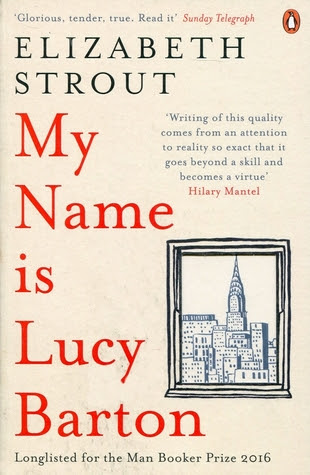
My Name is Lucy Barton by Elizabeth Strout


193 Pages 

Publisher: Penguin

Book Club Read


Blurb

Lucy Barton is recovering slowly from what should have been a simple operation. Her mother, to whom she hasn't spoken for many years, comes to see her. Her unexpected visit forces Lucy to confront the tension and longing that have informed every aspect of her life: her impoverished childhood in Amgash, Illinois, her escape to New York and her desire to become a writer, her faltering marriage, her love for her two daughters.


Knitting this powerful narrative together is the brilliant storytelling voice of Lucy herself: keenly observant, deeply human, and truly unforgettable. In My Name Is Lucy Barton, one of America's finest writers shows how a simple hospital visit illuminates the most tender relationship of all-the one between mother and daughter.


Review

My Name is Lucy Barton was a fascinating read. For the longest time, I wasn’t sure exactly what I was reading. At first, the story felt fragmented and confused; it went back and forth in time and since it was told in short paragraphs and chapters, it initially also felt incomplete.

This improved as I got further into the story, though. Or maybe, my perception of it changed once I recognised that the story was told the way our thought processes work; rarely linear and often jumping from time to time and topic to topic.

As the blurb states, this is a tale of a woman who has more or less completely cut herself off from her impoverished and often cruel childhood. But while it is possible to take oneself away from a situation, it is much harder to separate ourselves from the person who experienced that situation. While Lucy is in hospital, she has plenty of time to contemplate her life, who she is, and how she relates to her life and the people she has encountered. Her mother’s visit, which is completely out of character for the mother Lucy remembers, adds new angles to Lucy’s memories as she discovers that it is impossible to leave yourself in the past.

Where I disagree with the blurb, or rather, where I feel the blurb is incomplete is where it implies that the whole story is about the mother-daughter relationship. To me this was the story about Lucy discovering who she is, both because of and despite her fractious relationship with her past and family. It is only through reassessing what has gone before that she can move ahead and arrive at the point where she can say “My name is Lucy Barton” and fully (or as fully as any of us ever can) understand what that means.

My final thought about this book is that I had to remind myself more than once that I was reading a novel, a work of fiction, and not a memoir. I haven’t decided yet whether that is a pro or a con. 😊


Thursday, 2 June 2022

Panenka by Rónán Hession


166 pages

Publisher: Bluemoose


Blurb

His name was Joseph, but for years they had called him Panenka, a name that was his sadness and his story. Panenka has spent 25 years living with the disastrous mistakes of his past, which have made him an exile in his home town and cost him his dearest relationships. Now aged 50, Panenka begins to rebuild an improvised family life with his estranged daughter and her seven year old son.

But at night, Panenka suffers crippling headaches that he calls his Iron Mask. Faced with losing everything, he meets Esther, a woman who has come to live in the town to escape her own disappointments. Together, they find resonance in each other’s experiences and learn new ways to let love into their broken lives.

Review

I read Leonard and Hungry Paul by Rónán Hession just under a year ago and adored the book. As I wrote at the time, ‘it is a quiet read…sweet, uplifting, and all the more thought-provoking for it’. So, I went into Panenka with high expectations and I’m very happy to report that I wasn’t disappointed.

Like its predecessor, Panenka is anything but an action-filled page turner. And yet, the story gripped me from the very start, and I would have found it next to impossible to put the book down for long. Thankfully, there was no need for me to be away from the story for any length of time after I started reading.

This is very much a character-driving story. A story about life, the moments that define us, and the always present opportunity to choose differently and, maybe, do better. For the most part (and with the possible exception of Panenka himself), the issues the characters in this book face aren’t huge, or earth-shattering. That makes them all the more recognisable. And the same is true for the way they deal with their situations. And that’s what made this book so special for me. It doesn’t create drama for the sake of it, because life, with its ups and downs, is dramatic enough without overstating the facts.

What most impressed me about Panenka and its predecessor is the apparent discrepancy between what appears to be a simple and subdued story and the glorious, thoughtful, and thought-provoking language in which is told. So many sentences and paragraphs stopped me in my tracks. I’d re-read them while pondering the message or admiring the choice of word, the imagery, the depth. I’m sharing a few examples below, but I was spoiled for choice in this book and could easily have come up with a much, much longer list.

“It struck him how unreliable age was as a measure of anything. All it did was count the distance from the start when what truly mattered was the time remaining.” (p.63)

“Well look at us. I could have asked for the full tour – you could have shown me around all your own facts and circumstances, given me the tourist board version of yourself. A whole story that I would later have to revise or unlearn based on who you turned out to be. Bit if I start with what you’re actually like, pick you up where I found you, then at least I’m starting with my information. I can sketch you my won way, and then colour you in over time.” (p.99)

“At times this place has been like quicksand. At other times like the centre of the world.” (p.112)

“Sometimes, as I get older, I wonder whether all that’s left are the unfixable things.” (p.115)

“Loneliness is a torch. It can show you things about yourself.” (p.123)

“But isn’t that what allowing yourself to be loved is all about – letting something greater than fear into your life?” (p.160)


Long review short. Panenka is a treasure of a book. The quiet story it tells is filled with humanity. It touched me deeply without ever turning sentimental. Between Leonard and Hungry Paul and Panenka, Rónán Hession has earned his place on my list of ‘must-read authors’.