Showing posts with label Literature. Show all posts

Thursday, 30 March 2023

Nora by Nuala O’Connor


426 pages

Publisher: New Island Books

Library book

Book Club Read


Blurb

Dublin, 1904. Nora Joseph Barnacle is a twenty-year-old from Galway working as a maid at Finn’s Hotel. She enjoys the liveliness of her adopted city and on June 16—Bloomsday—her life is changed when she meets Dubliner James Joyce, a fateful encounter that turns into a lifelong love. Despite his hesitation to marry, Nora follows Joyce in pursuit of a life beyond Ireland, and they surround themselves with a buoyant group of friends that grows to include Samuel Beckett, Peggy Guggenheim, and Sylvia Beach.

But as their life unfolds, Nora finds herself in conflict between their intense desire for each other and the constant anxiety of living in poverty throughout Europe. She desperately wants literary success for Jim, believing in his singular gift and knowing that he thrives on being the toast of the town, and it eventually provides her with a security long lacking in her life and his work. So even when Jim writes, drinks, and gambles his way to literary acclaim, Nora provides unflinching support and inspiration, but at a cost to her own happiness and that of their children.

 With gorgeous and emotionally resonant prose, Nora is a heartfelt portrayal of love, ambition, and the quiet power of an ordinary woman who was, in fact, extraordinary.


Review

This is going to be one of my ‘I’m not entirely sure what to say’ reviews.

Don’t get me wrong. Nora’s story captivated me. I loved her voice and the way she picked her words and formulated her sentences.

“Sometimes I crave a little alone time to just let my thoughts scatter.”

That’s just one example. I have a much longer list of Nora-sayings written down in my reading-notebook.

Nora was also an easy read in so far that I got swept up in the tale, found it hard to put the book down, and couldn’t wait to get back to it when I had to pause my reading. At the same time, Nora is anything but an easy read when it comes to the content of her story and in my mind, I retitled it…

The things we do for love…

Because you would need to love somebody deeply in order to put up with everything Jim Joyce put Nora through. From James refusing to marry her for the longest time, through the various locations where they lived in sometimes abject poverty dependent on others just to keep a roof over their growing family’s heads and food on the table, to a life led making sacrifices for James’s art, it takes someone special and an extraordinary level of love and trust to stay the distance.

I wonder if I would have had a better understanding of Nora and James if I’d known more about them and if it would have made a difference if I had read, for example, Ulysses and Finnegan’s Wake.

 I’m not sure how to write this review without summarising the journey the Joyce family made, and honestly, if you're curious about that, you're far better off reading this beautiful book.

Ultimately, Nora was a gorgeously written book about an anything-but-easy life. I was happily surprised to discover it was universally loved and admired by the members of my reading group, even if one or two felt the need to remark on the more erotic scenes in the story. I’m very happy I read this story. And it just goes to show that it is indeed true that behind every great man there’s a great woman because it is hard to imagine James Joyce reaching the heights he achieved without Nora facilitating his life and art.



Monday, 25 July 2022

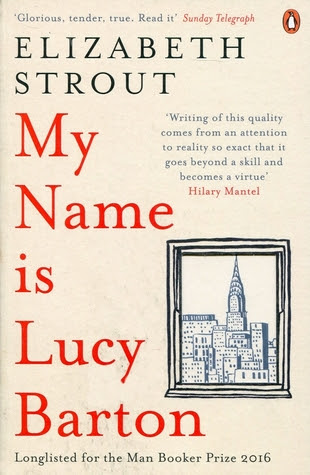
My Name is Lucy Barton by Elizabeth Strout


193 Pages 

Publisher: Penguin

Book Club Read


Blurb

Lucy Barton is recovering slowly from what should have been a simple operation. Her mother, to whom she hasn't spoken for many years, comes to see her. Her unexpected visit forces Lucy to confront the tension and longing that have informed every aspect of her life: her impoverished childhood in Amgash, Illinois, her escape to New York and her desire to become a writer, her faltering marriage, her love for her two daughters.


Knitting this powerful narrative together is the brilliant storytelling voice of Lucy herself: keenly observant, deeply human, and truly unforgettable. In My Name Is Lucy Barton, one of America's finest writers shows how a simple hospital visit illuminates the most tender relationship of all-the one between mother and daughter.


Review

My Name is Lucy Barton was a fascinating read. For the longest time, I wasn’t sure exactly what I was reading. At first, the story felt fragmented and confused; it went back and forth in time and since it was told in short paragraphs and chapters, it initially also felt incomplete.

This improved as I got further into the story, though. Or maybe, my perception of it changed once I recognised that the story was told the way our thought processes work; rarely linear and often jumping from time to time and topic to topic.

As the blurb states, this is a tale of a woman who has more or less completely cut herself off from her impoverished and often cruel childhood. But while it is possible to take oneself away from a situation, it is much harder to separate ourselves from the person who experienced that situation. While Lucy is in hospital, she has plenty of time to contemplate her life, who she is, and how she relates to her life and the people she has encountered. Her mother’s visit, which is completely out of character for the mother Lucy remembers, adds new angles to Lucy’s memories as she discovers that it is impossible to leave yourself in the past.

Where I disagree with the blurb, or rather, where I feel the blurb is incomplete is where it implies that the whole story is about the mother-daughter relationship. To me this was the story about Lucy discovering who she is, both because of and despite her fractious relationship with her past and family. It is only through reassessing what has gone before that she can move ahead and arrive at the point where she can say “My name is Lucy Barton” and fully (or as fully as any of us ever can) understand what that means.

My final thought about this book is that I had to remind myself more than once that I was reading a novel, a work of fiction, and not a memoir. I haven’t decided yet whether that is a pro or a con. 😊


Wednesday, 28 March 2018

The Picture of Dorian Gray by Oscar Wilde - Review


242 pages
Publisher: Penguin
Reading Group Read

Blurb

Dorian Gray is young, rich and beautiful. When he sees an exquisite portrait of himself, he is bewitched and offers his soul in exchange for eternal youth and good looks.

Under the corrupting influence of his friend Lord Henry Wotton, Dorian becomes drawn into a double life, indulging his every desire in a secret world of pleasure and excess, while remaining a gentleman in the eyes of polite society. Only his portrait bears the traces of his decadence.

And as Dorian’s behaviour sinks further into debauchery and cruelty, the bargain he has struck looks set to destroy him …

Review

“Like the painting of a sorrow,
A face without a heart.”

Technically, this was a re-read for me. Given that I was a teenager when I first (and last) read this book, it is hardly surprising that I didn’t remember much about of the story except for the main storyline in the broadest of terms.

I’m not quite sure what to say about this book. I can’t honestly say I liked it, in the literal meaning of like. The book’s theme and main character are too depraved to use that word. Having said that, it was a great read; fascinating in a car-crash sorta way. I found myself both horrified and fascinated most of the time, eager to keep on reading despite the fact that I knew how the story was going to end.

The following is not so much a review as a collection of thoughts that occurred to me while reading.

I do wonder what would have happened to Dorian if he hadn’t been so easily influenced by Basil Hallward’s statements about the temporary nature of beauty and Lord Henry’s overall irreverence and bad influence. Lord Henry is the sort of person who manages to sprout all sorts of nonsense in such a way that at first glance it all sounds credible, if not deep and profound. In fact, I think Henry is the real villain in this story since it is his desire to corrupt Dorian and watch what will happen, that pushes the story into gear.

“Faithfulness is to the emotional life what consistency is to the life of the intellect — simply a confession of failure.” – Lord Henry

What struck me about this story, or rather, the way the main characters approach life, was the frivolity of it all. No feeling, experience, or even thought seems to linger or hold its value for more than a few hours at best. When Dorian first discovers Sybil has killed herself after his careless dismissal of her, he is grief-stricken and filled with guilt. But, only a matter of hours later Dorian discovers the first, subtle, change in his portrait and he decides to abandon his morals.

“Eternal youth, infinite passion, pleasures subtle and secret, wild joys and wilder sins — he was to have all these things. The portrait was to bear the burden of his shame; that was all.”

It’s impossible to read this book and not marvel at how times have changed. Dorian is supposed to be evil, or at least corrupted and guilty of corrupting others, and yet, to modern eyes, we do not see any evidence of that (although there’s plenty to prove his selfishness). Sure, breaking up with Sybil was cruelly done, but considering they only knew each other for a matter of weeks it was the haste of their engagement which startled me more than the fact he changed his mind (be it for frivolous reasons, as his falling in love with her had been). Other misdeeds are referred to but with so little detail that you couldn’t even call it hinting at misdeeds. The only other less than respectable thing we witness, is Dorian visiting an opium den. Opium use may have been something which was frowned upon in Oscar Wilde’s time, but these days drug use, while under certain circumstances certainly harmful, is nowhere near as shocking. The only proof we have that Dorian has lead a less than positive life are his own proclamations of the same and, of course, the portrait. Having said that, there is something to be said for undisclosed (dark?) secrets; it’s impossible to deny that they’re both frustrating and enticing. And of course my imagination is a wondrous (horrendous?) thing. Of course, censorship being what it was, Oscar Wilde couldn’t have gone into the details of Dorian’s misdeeds if he’d wanted to.

And morality is not the only thing that has changed over time. If I were to submit a story written the way ‘The Picture of Dorian Gray’ is to my editor, she would tell me to scrap whole chapters. These days writers just don’t get away with long sections, never mind whole chapters, filled with nothing but introspection.

I have plenty more thoughts and quotes, but I’ll keep them to myself; this review is quite long enough. I’ll end it with the following.

That the novel was a success de scandale does not surprise me at all. I am however mystified as to how the book was later used as evidence against Wilde at the Old Bailey in 1895. It really requires a rather determined form of reading between the lines in order to conclude homosexuality. Then again, maybe this too is a sign of the times. It is of course quite possible that sentences that I read as straightforward would have had a different or double meaning in Wilde’s time.

I started the book with a quote, so I’ll end it with one as well. This one was picked because it gives me great comfort, even if I’m inclined to think it means no such thing. J

“Diversity of opinion about a work of art shows that the work is new, complex and vital.”