Saturday, 25 February 2023

And Then There Were None by Agatha Christie


276 pages

Kindle edition

First published November 6, 1939

Book Club read February 2023


Blurb

First, there were ten - a curious assortment of strangers summoned as weekend guests to a private island off the coast of Devon. Their host, an eccentric millionaire unknown to all of them, is nowhere to be found. All that the guests have in common is a wicked past they're unwilling to reveal - and a secret that will seal their fate. For each has been marked for murder. One by one they fall prey. Before the weekend is out, there will be none. And only the dead are above suspicion.


Review


Ten little soldier boys went out to dine;

One choked his little self and then there were Nine.

Nine little soldier boys sat up very late;

One overslept himself and then there were Eight.

Eight little soldier boys travelling in Devon;

One said he’d stay there and then there were Seven.

Seven little soldier boys chopping up sticks;

One chopped himself in halves ad then there were Six.

Six little soldier boys playing with a hive;

A bumble bee stung one and then there were Five.

Five little soldier boys going in for law;

One got in Chancery and then there were Four.

Four little soldier boys going out to sea;

A red herring swallowed one and then there were Three

Three little soldier boys walking in the Zoo;

A big bear hugged one and then there were Two.

Two little soldier boys sitting in the sun;

One got frizzled up and then there was One.

One little soldier boy left all alone;

He went and hanged himself and then there were None.


From the Author’s Note:

I had written this book because it was so difficult to do that the idea fascinated me.

As for me, I was fascinated from the opening few paragraphs describing several people making their way to a place called Soldier Island. Their destination may be the same, but they don’t know each other, aren’t aware others are making the same journey, or that they’ve all been invited under a different pretence.

As the blurb suggests, the guests are in for one or two unpleasant surprises. And chief among those is the fact that one by one they will be killed as punishment for deaths they have caused in the past but gotten away with.

I do not want to spoil this book for anybody who may not be familiar with the story or for those who, like me, read it so long ago that they've forgotten every single detail. Suffice to say that I was mesmerized by this tale and not just because it appeared to be an impossible crime. Once it becomes clear that the eight guests and two servants are the only people on the island, we know that the only possible explanation is that one of them has to be the deranged murderer. But if all of them die, how can that possibly be the case?

It's not just the mystery of who and how that kept me captivated. The slow but steady slide from disbelief via fear and anger to utter paranoia was fascinating. It was also very cleverly executed because Christie has a very light touch. In fact, if I had to pick one facet of this story that stood out over all others it would be her ability to show her reader darkness without ever spelling it out or layering it on with heavy strokes.

I have to hand it to Agatha Christie. Yes, the idea for this story is fascinating and it reads like an impossible-to-resolve mystery (even) more than her other stories. Yet, once all was revealed at the end of the story—and therefore much too late to save anybody’s life—it did makes sense and both motivation and means of execution convinced me. I’m not sure why that should surprise me; they don’t call Christie the Queen of Crime for nothing. 😊 In fact, if it hadn’t been for the wonderful and in-depth All About Agatha podcast, I would have been oblivious about the one plotting ‘mistake’ in this story.


I am delighted I picked this book for my book club and can’t wait for the discussion. Reading And Then There Were None also has made me even more determined to revisit more Agatha Christie mysteries. I rarely re-read any books but I’m looking forward to making an exception for her mysteries.


Wednesday, 22 February 2023

My Father's House by Joseph O'Connor

 My Father’s House (Rome Escape Line Trilogy #1) by Joseph O’Connor


276 pages

Publisher: Harvill Secker

Pub. Date: Jan 2023


Blurb

From the best-selling author of Star of the Sea, a WWII-era “great escape” novel set in the Vatican

September 1943: German forces occupy Rome. Gestapo boss Obersturmbannführer Paul Hauptmann rules with terror. Hunger is widespread. Rumors fester. The war’s outcome is far from certain.

Diplomats, refugees, and escaped Allied prisoners flee for protection into Vatican City, at one fifth of a square mile the world’s smallest state, a neutral, independent country within Rome. A small band of unlikely friends led by a courageous Irish priest is drawn into deadly danger as they seek to help those seeking refuge.

Book 1 in the Rome Escape Line Trilogy, My Father’s House is a powerful, heartbreaking literary thriller based on the true story of Monsignor Hugh O’Flaherty, who risked his life to smuggle thousands of Jews and escaped Allied prisoners out of Italy under the nose of his Nazi nemesis. A deadly high-stakes battle of wits ensues in this astonishing, unforgettable story of love, faith and sacrifice, exploring what it means to be truly human in the most extreme circumstances.


Review

I must start this review with a confession. I knew the story I was about to start reading was based on real events and that knowledge made me nervous. So I googled Monsignor Hugh O’Flaherty first because I had to know whether or not he survived the war, just to prepare myself for the worst in case he didn’t.

Revealing here that my search told me he lived until 1963 is not a spoiler so I don’t mind sharing the fact. I’m sure that many readers—Irish people and history buffs for starters—will be well aware of the man and his brave deeds before picking up this book. It is far more important to also let you know that my prior knowledge did nothing to lessen the relentless tension resulting from O’Flaherty’s Christmas Eve forbidden forage into Rome.

I’ve decided not to go into the story details here. The blurb gives a far better summary of what this story is about than I could put together. I will therefore ‘limit’ myself to how I experienced the story and my thoughts while reading.

It’s hard to pigeonhole this book. While the quality of the writing marks it as a literary work, it read very much like a thriller. There was so much tension in this story. It isn’t lack of fear that makes people brave. It is pushing ahead despite a full awareness of the risks involved that turns ordinary people courageous.

Monsignor O’Flaherty and his Choir of co-conspirators weren’t trained professionals. Nothing in their lives had prepared them for the act of standing up to an oppressor without mercy or humanity. They were pushed into action by their inability to see the needless and cruel suffering of others. Such acts of courage take my breath away and despite already knowing that all would be well in the end, my heart beat faster and my nerves spiked as the dangers increased. The fact that the members of the choir were all too aware of the risk they took, and of the almost unimaginable consequences should they be caught, only made my anxiety worse and my reading experience more intense.

I appreciated that the story was told from several perspectives. While, for obvious reasons, a lot of attention is fixed on O’Flaherty and his thoughts and actions, the contributions from the members of the Choir he assembled give us a fuller idea both of who the Monsignor was and of the varied and fascinating composition of their group. The fact that most of those contributions were dated decades after the war had ended also reassured me that whatever might happen next, the characters I grew to care for more with every passing page, would survive the ‘adventure’ too.

While the book gives voice to the thoughts of O’Flaherty and several of his allies, we also get glimpses into the head of his main opponent, Obersturmbahnführer Paul Hauptmann. As is so often the case when it comes to evil, the most shocking thing about his sections wasn’t his enthusiasm when it came to trying to stay in Hitler’s good books and inflicting pain and death on those he saw as his enemies, but the moments in which he seemed almost normal. It’s hard to imagine evil-personified as also being a loving husband and father, as a person who appreciates art and history. I almost didn’t want to read those pages. It was so much easier to imagine him as pure evil, without any redeeming qualities.

Of course, the reverse is true, too. While there is no doubt that O’Flaherty and the members of his Choir were good people—the best of us even—the story showed them as only too human, with doubts, fears, and moments in which their thoughts weren’t all that loving or even ‘Christian’. All of which added to the realism of this story and all of which will mean that these characters and their acts will stay with me that much longer.

If I have a quibble, it is minor.

The descriptions in this book are gorgeous and vivid. They are also long and ever-present. There was a moment or two, especially during the breathtaking quest on Christmas Eve that such descriptions pulled me out of the tension for a moment or two. Then again, maybe that was just as well. Besides, while this is certainly a thrilling story, it is not a typical thriller so there is no reason why it should follow genre requirements connected to such stories.

Overall, My Father’s House is a fascinating, at times heart-stopping, and gorgeously written story about courage in the face of despair. It is also a timely reminder that even when the world seems to be at its darkest, there are always those who are willing to risk all. Not for personal gain or fame but simply because it’s the right thing to do.


Monday, 25 July 2022

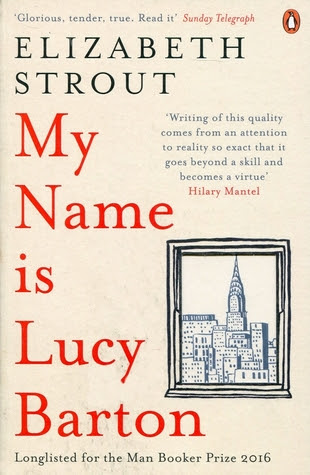
My Name is Lucy Barton by Elizabeth Strout


193 Pages 

Publisher: Penguin

Book Club Read


Blurb

Lucy Barton is recovering slowly from what should have been a simple operation. Her mother, to whom she hasn't spoken for many years, comes to see her. Her unexpected visit forces Lucy to confront the tension and longing that have informed every aspect of her life: her impoverished childhood in Amgash, Illinois, her escape to New York and her desire to become a writer, her faltering marriage, her love for her two daughters.


Knitting this powerful narrative together is the brilliant storytelling voice of Lucy herself: keenly observant, deeply human, and truly unforgettable. In My Name Is Lucy Barton, one of America's finest writers shows how a simple hospital visit illuminates the most tender relationship of all-the one between mother and daughter.


Review

My Name is Lucy Barton was a fascinating read. For the longest time, I wasn’t sure exactly what I was reading. At first, the story felt fragmented and confused; it went back and forth in time and since it was told in short paragraphs and chapters, it initially also felt incomplete.

This improved as I got further into the story, though. Or maybe, my perception of it changed once I recognised that the story was told the way our thought processes work; rarely linear and often jumping from time to time and topic to topic.

As the blurb states, this is a tale of a woman who has more or less completely cut herself off from her impoverished and often cruel childhood. But while it is possible to take oneself away from a situation, it is much harder to separate ourselves from the person who experienced that situation. While Lucy is in hospital, she has plenty of time to contemplate her life, who she is, and how she relates to her life and the people she has encountered. Her mother’s visit, which is completely out of character for the mother Lucy remembers, adds new angles to Lucy’s memories as she discovers that it is impossible to leave yourself in the past.

Where I disagree with the blurb, or rather, where I feel the blurb is incomplete is where it implies that the whole story is about the mother-daughter relationship. To me this was the story about Lucy discovering who she is, both because of and despite her fractious relationship with her past and family. It is only through reassessing what has gone before that she can move ahead and arrive at the point where she can say “My name is Lucy Barton” and fully (or as fully as any of us ever can) understand what that means.

My final thought about this book is that I had to remind myself more than once that I was reading a novel, a work of fiction, and not a memoir. I haven’t decided yet whether that is a pro or a con. 😊


Thursday, 2 June 2022

Panenka by Rónán Hession


166 pages

Publisher: Bluemoose


Blurb

His name was Joseph, but for years they had called him Panenka, a name that was his sadness and his story. Panenka has spent 25 years living with the disastrous mistakes of his past, which have made him an exile in his home town and cost him his dearest relationships. Now aged 50, Panenka begins to rebuild an improvised family life with his estranged daughter and her seven year old son.

But at night, Panenka suffers crippling headaches that he calls his Iron Mask. Faced with losing everything, he meets Esther, a woman who has come to live in the town to escape her own disappointments. Together, they find resonance in each other’s experiences and learn new ways to let love into their broken lives.

Review

I read Leonard and Hungry Paul by Rónán Hession just under a year ago and adored the book. As I wrote at the time, ‘it is a quiet read…sweet, uplifting, and all the more thought-provoking for it’. So, I went into Panenka with high expectations and I’m very happy to report that I wasn’t disappointed.

Like its predecessor, Panenka is anything but an action-filled page turner. And yet, the story gripped me from the very start, and I would have found it next to impossible to put the book down for long. Thankfully, there was no need for me to be away from the story for any length of time after I started reading.

This is very much a character-driving story. A story about life, the moments that define us, and the always present opportunity to choose differently and, maybe, do better. For the most part (and with the possible exception of Panenka himself), the issues the characters in this book face aren’t huge, or earth-shattering. That makes them all the more recognisable. And the same is true for the way they deal with their situations. And that’s what made this book so special for me. It doesn’t create drama for the sake of it, because life, with its ups and downs, is dramatic enough without overstating the facts.

What most impressed me about Panenka and its predecessor is the apparent discrepancy between what appears to be a simple and subdued story and the glorious, thoughtful, and thought-provoking language in which is told. So many sentences and paragraphs stopped me in my tracks. I’d re-read them while pondering the message or admiring the choice of word, the imagery, the depth. I’m sharing a few examples below, but I was spoiled for choice in this book and could easily have come up with a much, much longer list.

“It struck him how unreliable age was as a measure of anything. All it did was count the distance from the start when what truly mattered was the time remaining.” (p.63)

“Well look at us. I could have asked for the full tour – you could have shown me around all your own facts and circumstances, given me the tourist board version of yourself. A whole story that I would later have to revise or unlearn based on who you turned out to be. Bit if I start with what you’re actually like, pick you up where I found you, then at least I’m starting with my information. I can sketch you my won way, and then colour you in over time.” (p.99)

“At times this place has been like quicksand. At other times like the centre of the world.” (p.112)

“Sometimes, as I get older, I wonder whether all that’s left are the unfixable things.” (p.115)

“Loneliness is a torch. It can show you things about yourself.” (p.123)

“But isn’t that what allowing yourself to be loved is all about – letting something greater than fear into your life?” (p.160)


Long review short. Panenka is a treasure of a book. The quiet story it tells is filled with humanity. It touched me deeply without ever turning sentimental. Between Leonard and Hungry Paul and Panenka, Rónán Hession has earned his place on my list of ‘must-read authors’.


Sunday, 17 April 2022

Girl A by Abigail Dean


326 pages

Publisher: HarperCollins

Book Club Read


Blurb

Lex Gracie doesn't want to think about her family. She doesn't want to think about growing up in her parents' House of Horrors. And she doesn't want to think about her identity as Girl A: the girl who escaped, the eldest sister who freed her older brother and four younger siblings. It's been easy enough to avoid her parents--her father never made it out of the House of Horrors he created, and her mother spent the rest of her life behind bars. But when her mother dies in prison and leaves Lex and her siblings the family home, she can't run from her past any longer. Together with her sister, Evie, Lex intends to turn the House of Horrors into a force for good. But first she must come to terms with her siblings - and with the childhood they shared.


Review


Yet another book where I’m not quite sure what to make of it.

This is what it says on the back of the paperback:

‘Girl A’, she said. ‘The girl who escaped. If anyone was going to make it, it was going to be you.’

I am Lex Gracie: but they call me Girl A.

I grew up with my family on the moors.

I escaped when I was fifteen years old.

NOW SOMETHING IS PULLING ME BACK…


And that is followed by ‘The biggest mystery thriller since Gone Girl’ – Elle.

The description and the blurb sounded intriguing and pulled me in as soon as I read them. But… Whatever this story is, it is not a mystery or a thriller. It’s a fascinating story, that’s for sure, but in a ‘car-crash-I-should-look-away-but-I-can not' sorta way. Sure, there are one or two shocking and unexpected revelations (which for obvious reasons I won’t go into) in this book, but most of what the reader gets is revealed in the blurb and in the first chapter.

This is the story of a family in crisis. Of a father becoming so obsessively religious that he puts his children in mortal danger, and a mother who isn’t strong enough (or too devoted to her husband?) to interfere on behalf of her children. It gives a fascinating view of how the circumstances affect every child a little differently. While they all suffer, they don’t suffer or deal with their suffering in identical ways.

Alexandra (Lex) – Girl A; the one who got away and saved her siblings.

Ethan – Boy A; as the oldest child he had privileges or was being groomed by his father to follow in his footsteps. He creeped my out, especially since he is referred to as a sociopath by one of his siblings. What creeped me out even more was that none of the siblings felt the need to warn his wife-to-be about the risks she faced if she married him.

Delilah – Girl B; described as a bit of a pretty airhead, she may have been smarter than the others in that she managed to charm those around her, including her father to some extent.

Gabriel – Boy B; ruined by his adoptive parents’ dreams of fame based on his nightmarish past as much as his horrific real family and everything that happened there.

Noah – Boy D; the only one young enough to have no memories of the horrors inflicted on the others and for that reason kept away from his siblings in an effort by his adoptive parents to give him a ‘normal’ life.

Evie – Girl C; the sibling closed to Lex.

Daniel – The only child without a chapter who would have been ‘Boy C’.

Of course, since the book is told only from Girl A’s perspective, we don’t necessarily get an accurate description of how her siblings experience and deal with their early years. All we know is what Girl A has observed and the conclusions she has drawn from that.

Although Lex’s escape and some of the horrors leading up to that moment are revealed very early on, there were huge stretches of the story where things didn’t seem that bad. The horror of their situation creeps up on the reader, just as it would have crept up on the children. As a result, the read became increasingly uncomfortable for me. I knew things had to get horrific in order to live up to both the book blurb and Lex finding the courage to escape the chains that bound her, but there was a long stretch where it was possible for me to believe that maybe it wouldn’t be that bad.

As I said, this book didn’t read as a mystery or thriller for me. It felt more like a character study; a description of how even when trapped in the same nightmare, all participants come out of it with different memories, different defense mechanisms, and different (lasting) consequences.

Finally, there is something I didn’t know before I started this book and now that I do know, I’m not sure how I feel about it. As it turns out, this story is based on a real-life domestic tragedy known as the Turpin family saga. Click the link if you would like to know more about that.

Overall, I’m not sure how I feel about this book. While it was a captivating read, it wasn’t at all what I expected. There were a few questions I would have liked a (clearer) answer to and, most frustratingly, I have no idea how the book ended. I mean, I read all of it, but I couldn’t tell you if that ending was hopeful or heart-breaking. The fact that I don’t really care what the answer to that conundrum is, explains my 3 ½ stars rating.  


Tuesday, 5 April 2022

Exciting Times by Naoise Dolan


Publisher: Weidenfeld & Nicolson

275 pages

Book Club Read / Part of The Art of Reading Book Club with Colm Tóbín


Blurb


When you leave Ireland aged 22 to spend your parents’ money, it’s called a gap year. When Ava leaves Ireland aged 22 to make her own money, she’d not sure what to call it, but it involves:

  • A badly-paid job in Hong Kong, teaching English grammar to rich children;
  • Julian, who likes to spend money on Ava and lets her move into his guest room;
  • Edith, who Ava meets while Julian is out of town and actually listens to her when she talks;
  • Money, love, cynicism, unspoken feelings and unlikely connections

Exciting times ensue.


Review

I may have gone into this book a little prejudiced. My daughter warned me I probably wouldn’t like it. As much as I would have loved for her to be wrong, I’m afraid she knows me very well and was spot on. It appears that Colm Toibin and I are not on the same page when it comes to preferred fiction…at all.

I didn’t like Ava. I know young people (myself included at that time) can be rather self-obsessed, but I found Ava particularly selfish. Everything is about her and if she does consider others, i.e. Julian and Edith, it is mostly in terms of how they relate to her, how they affect or improve her life. Sure, towards the end of the book she does appear to go on a bit of a journey and seems to gain some insight into how her actions and lack thereof affect Edith, but for me it was too little too late. What’s more, if I had been Edith, I would have told her as much and moved on…fast.

Despite what Ava continuously tells herself and the reader, I couldn’t help feeling that Julian was her victim too. Surely the fact that he does ask her to move to Hamburg with him indicates that he is more attached to her than he has been willing to admit. Surely her initial agreement followed by her last moment change of mind means that she now inflicts the same level of hurt on him as she inflicted on Edith earlier in the story? Does she even let him know she’s changed her mind about following him?

To be fair, I didn’t have a hard time reading this book and I wasn’t tempted to not finish it at any time. On the other hand, I found it impossible to connect to any of the three main characters. I never figured out why they were attracted to each other or what they got out of sharing time (and bodies). While Ava’s motivation seems obvious that is only true when it comes to her finding a luxurious roof over her head without having to part with money. What either Julian or Edith gets out of being with Ava never became clear to me.

A few notes I took while reading:

  • I wonder if this book is (somewhat) pretentious, or if that’s ‘just’ me?
  • Is it me or is Ava rather pathetic in her neediness? Sure, she’s young (23) but is that an excuse for her using Julian and/or allowing Julian to use her?
  • Why is she attracted to Edith?
  • On page 149 I came across an observation Edith makes about Ava that feels rather apt:


“You keep describing yourself as this uniquely damaged person, when a lot of it is completely normal. I think you want to feel special—which is fair, who doesn’t—but you don’t allow yourself to feel special in a good way, so you tell yourself you’re especially bad.”

 To me that sounds like just more self-indulgence. If she tells herself she’s bad, she doesn’t have to take a close(r) look at why she acts the way she does.

  • It would help if I understood why both Julian and Edith want Ava in their lives. Nothing in her narrative makes her attractive in my eyes.
  • It’s funny how, in a book written from a first-person perspective, I never felt as if I got the know Ava. Mind you, Julian and Edith, as seen and described by Ava, weren’t any clearer.
  • Conclusion: MEH! 

Maybe it is time for me to admit that (some) of the upcoming Irish writers are just not telling stories aimed at me. On the other hand, maybe I have to consider that I may be missing something when I’m reading books like this one. The long and short of it is that while this book was easy enough to read and the story enough of a trainwreck to keep my attention, I’m not overly impressed. ‘Exciting’ is not the term I would choose to describe the times in this story. For me ‘desperate’ would have been a more appropriate term.


Tuesday, 15 March 2022

Small Things Like These by Claire Keegan


 116 pages

Publisher Faber & Faber

Part of The Art of Reading Book Club with Colm Tóbín


Blurb

It is 1985, in an Irish town. During the weeks leading up to Christmas, Bill Furlong, a coal and timber merchant, faces his busiest season. As he does the rounds, he feels the past rising up to meet him – and encounters the complicit silences of a people controlled by the Church.

The long-awaited new work from the author of Foster, Small Things Like These is an unforgettable story of hope, quiet heroism and tenderness.


Review

“The worst was yet to come, he knew. Already he could feel a world of trouble waiting for him behind the net door, but the worst that could have happened was also already behind him; the thing not done, which could have been – which he would have had to live with for the rest of his life.” 

What to say about this book?

What to say about a story that left me both happy and dissatisfied?

Basically, this is the tale of a good man, Bill Furlong, paying it forward; performing an act of kindness that mirrors the similar act decades earlier, performed for his mother. I loved this aspect of the story. What’s not to like about a man confronting, facing, and overcoming his fears in order to do what is right?

I’m less happy that the story ended on the act, without showing us any of the consequences. Of course, it is easy enough to predict what might happen next, but I would have liked to see it unfold. As it is, I can imagine two very different outcomes and in an ideal (reading) world, I would have read about the positive option playing out. Maybe not immediately, but I like to think that in the end, Bill’s act of kindness would have been met by those who care for him, backing his decision. As it is, I will never know.

Then again, maybe that’s for the best. Rural Ireland in 1985 is not a place I recognise. Of course, my first visit to Ireland didn’t happen until two years later, but even what I saw, learned, and intuited at the time is nothing like what I encountered in this story. 1985, it doesn’t feel that long ago, but it is fair to say that Ireland has come a very long and mostly positive way since then. Based on the little I do know about those times and public attitudes back then; it is just as easy to imagine Bill’s act leading to the destruction of everything he holds dear.

I’m not entirely sure how I feel about the contrast between the way the story is told and what it is about. The writing is easy, gentle, and almost entirely without a sense of urgency. The content on the other hand is edgy, pressing, and filled with tension. Especially the first part of the book left me with the impression that I was reading a gentle vignette of times gone by. But the longer I lived with the words I’d read, the darker this apparently simple tale turned.

So, that’s where I’m at. Somewhat confused about how I feel about this story. It was beautifully written and deceptively easy to read. It was also darker than I expected, and it has left me with enough food for thought to last me days, if not weeks. While I’m not sure how much I liked Small Things Like These, I am very glad I’ve read it and I’m looking forward to (eventually) discussing this little gem with my book club.